
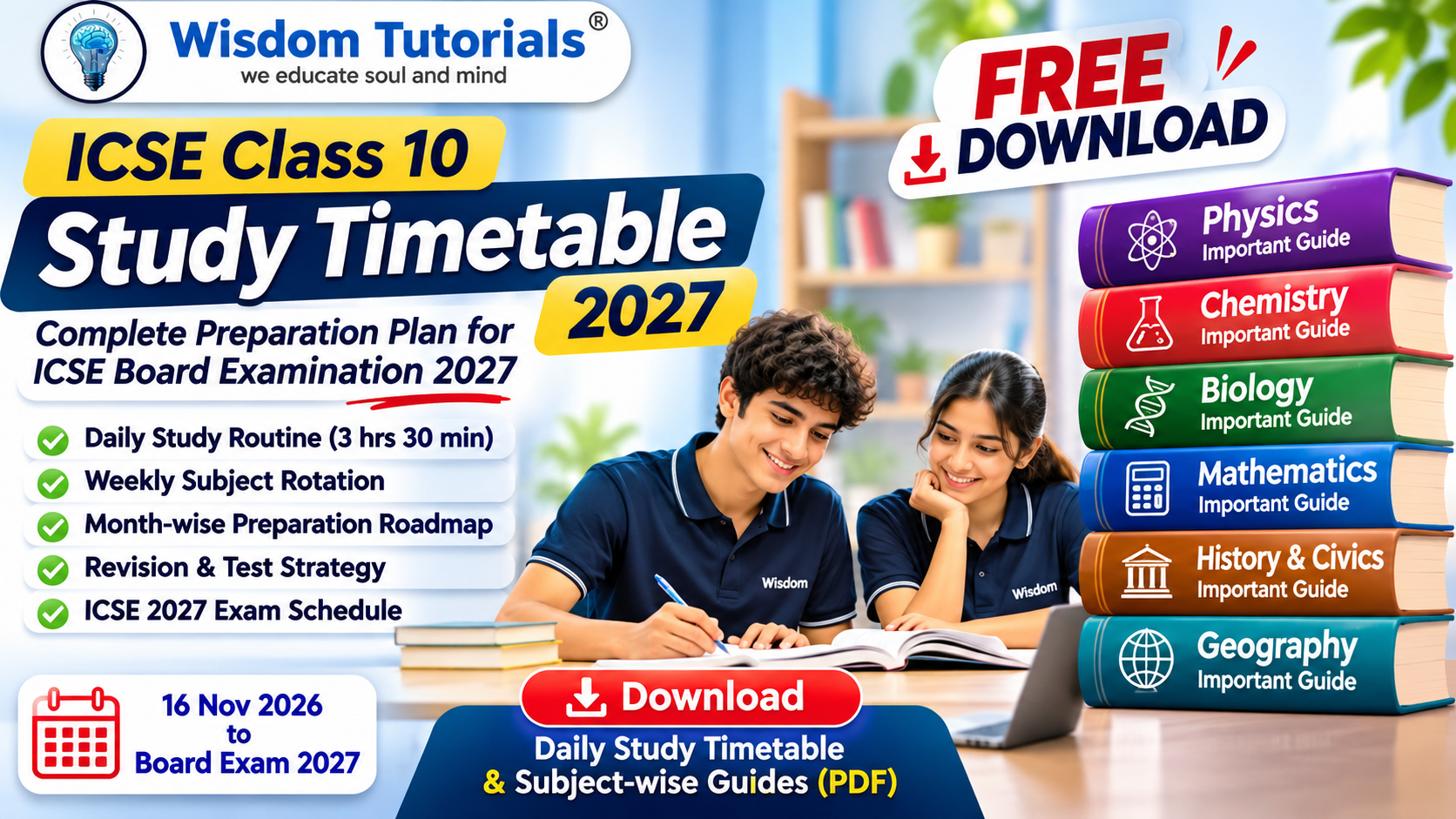
ICSE Class 10 Study Timetable 2027: A Practical Preparation Plan for Students & Parents
Class 10 is an important year in every student's academic journey. For ICSE students, the pressure can feel a little different because there are multiple subjects to manage, extensive syllabuses to complete and regular written practice to maintain.
As the ICSE Class 10 Board Examination 2027 approaches, students and parents often have similar questions:
How should I manage all my subjects?
How many hours should I study every day?
Which subjects need more attention?
When should I start solving previous-year question papers?
How can I complete the syllabus and still get enough time for revision?
Many students study for several hours but still feel unprepared. The reason is often not a lack of effort. It is the absence of a clear study routine.
Studying without a plan can lead to spending too much time on one subject while neglecting another. Before students realise it, examinations are approaching and revision is still incomplete.
A realistic study timetable can help avoid this situation.
Whether you are studying in an ICSE school in Palghar, Saphale, Boisar, Dahanu or anywhere else, this guide will help you organise your preparation for the 2027 board examinations.
We have also included a free downloadable daily study timetable and subject-wise important study guides to help students prepare more systematically.
1. Why Does Every ICSE Class 10 Student Need a Study Timetable?
Imagine two students preparing for the same examination.
The first student studies whichever subject comes to mind. Some days Mathematics gets three hours, while Physics or History may not be touched for several days.
The second student follows a weekly plan. Every subject has a dedicated time, difficult chapters receive additional attention, and Sunday is reserved for revision and self-assessment.
Both students may study for the same number of hours, but the second student has a more organised approach.
A study timetable helps students:
Maintain a balance between all subjects.
Complete the syllabus within the planned time.
Give extra attention to difficult chapters.
Develop regular revision habits.
Practise numerical and application-based questions.
Identify weak areas before examinations.
Avoid unnecessary last-minute pressure.
The purpose of a timetable is not to make students study continuously. It is to make their study hours more productive.
2. How Many Hours Should an ICSE Class 10 Student Study Daily?
There is no single number of study hours that works for every student.
Some students understand concepts quickly, while others need more time to practise numerical problems, written answers or diagrams.
However, apart from school and coaching hours, students should maintain dedicated self-study time every day.
Our recommended daily study plan includes 3 hours and 30 minutes of focused self-study.
| Study Session | Duration | Main Focus |
|---|---|---|
| Theory | 90 minutes | Understand concepts and revise chapters |
| Language | 45 minutes | Reading, grammar and writing practice |
| Practice | 75 minutes | Mathematics, numericals, diagrams and board questions |
| Total | 3 hours 30 minutes | Focused self-study |
Students can adjust the clock timings according to their school, coaching and personal routine.
The important thing is to complete the study sessions consistently.
Taking short breaks between sessions is also important to maintain concentration.
3. ICSE Class 10 Subject-Wise Weekly Study Timetable 2027
One of the biggest challenges in ICSE Class 10 is managing multiple subjects together.
Instead of deciding every day what to study, students can follow a weekly subject rotation.
Here is a suggested routine:
| Day | Theory – 90 Min | Language – 45 Min | Practice – 75 Min |
|---|---|---|---|
| Monday | Physics | English Language | Mathematics |
| Tuesday | Chemistry | Second Language / Other Subject | Geography / Computer Applications |
| Wednesday | Biology | English Literature | Mathematics |
| Thursday | History & Civics | Second Language / Other Subject | Physics |
| Friday | Geography | English Language | Mathematics |
| Saturday | Chemistry / Biology | English Literature / Other Subject | Science Practice |
| Sunday | Weekly Revision | Language Practice | Timed Test & Correction |
Important: This is a suggested weekly rotation, not a compulsory schedule. Every student should adjust the subjects and timings according to their school timetable, coaching schedule, pending syllabus and individual strengths and weaknesses.
For example, if you find Physics difficult, you can give it additional practice time. If you are already confident in Biology, you can use some of that time for another subject that needs attention.
The aim is to maintain balance while giving extra time wherever it is needed.
Why Is Every Subject Important?
Physics: Understand laws, formulas, concepts and numerical applications. Regular problem-solving is essential.
Chemistry: Focus on chemical equations, reactions, observations, organic chemistry and numerical questions.
Biology: Revise diagrams, terminology, functions and biological processes. Practise labelled diagrams regularly.
Mathematics: Solve problems every day. Understanding a formula is not enough; students must know how to apply it.
English Language: Practise grammar, comprehension, essays, letter writing and other prescribed formats.
English Literature: Understand the characters, themes, important extracts and central ideas of the prescribed texts.
History & Civics: Focus on important events, dates, causes, consequences and constitutional concepts.
Geography: Practise map work, topographical maps, geographical concepts and reason-based questions.
4. Month-Wise ICSE Class 10 Board Preparation Strategy
A timetable becomes more effective when students know what they should achieve during each stage of preparation.
Here is a suggested preparation roadmap for the 2027 examinations.
Phase 1: 16–30 November 2026 – Identify Your Weak Areas
Before starting intensive preparation, understand your current academic position.
Identify unfinished chapters.
Make a list of difficult topics.
Check your performance in previous tests.
Identify subjects that need additional attention.
Prepare realistic weekly targets.
Do not start studying randomly. First understand what needs to be completed.
Phase 2: 1–20 December 2026 – Complete the Remaining Syllabus
This phase should focus on completing pending chapters.
Students should:
Complete unfinished topics.
Clear doubts with subject teachers.
Finish assignments and practical records.
Revise important concepts.
Practise chapter-wise questions.
Avoid leaving difficult chapters for the final revision period.
Phase 3: 21 December 2026 – 10 January 2027 – First Revision and Paper Practice
Once a reasonable portion of the syllabus is completed, start solving previous-year questions and specimen papers alongside revision.
After every paper, check:
Which questions were answered incorrectly?
Which chapters need more revision?
Did you manage your time properly?
Were your answers presented correctly?
A test is useful only when you learn from your mistakes.
Phase 4: 11–31 January 2027 – Intensive Board Practice
This phase should include more examination-oriented practice.
Focus on:
Full-length specimen papers.
Previous-year question papers.
Time management.
Numerical accuracy.
Answer presentation.
Revision of weak chapters.
Try to solve papers under examination-like conditions.
Phase 5: February 2027 – Final Revision
The final revision period should be focused and organised.
Give attention to:
Important formulas.
Definitions and laws.
Chemical equations.
Diagrams and maps.
Important dates and events.
Frequently practised question formats.
Mistakes identified during mock tests.
Avoid collecting too many new books and resources at this stage. Revise what you have already studied.
Always follow the official CISCE examination schedule for the final subject-wise revision order.
5. Subject-Wise ICSE Class 10 Important Study Guides – Free PDF Download
Preparing for ICSE Class 10 becomes easier when students know which chapters require more attention and which topics need regular practice.
However, students often struggle to decide where to begin.
To make preparation more organised, Wisdom Tutorials is providing subject-wise important study guides for ICSE Class 10 students appearing for the 2027 Board Examination.
These guides are designed to help students identify important topics, revise chapters and practise examination-oriented questions.
You can access the subject-wise PDFs below.
🔬 1. ICSE Class 10 Physics Important Guide 2026–27
Physics requires conceptual understanding, formula application and regular numerical practice.
The study guide will help students organise their preparation and focus on important chapters and question practice.
[DOWNLOAD PHYSICS IMPORTANT GUIDE PDF]
🧪 2. ICSE Class 10 Chemistry Important Guide 2026–27
Chemistry requires a combination of theory, equations, reactions, observations and numerical practice.
The Chemistry guide includes:
Chapter-wise approximate weightage.
Important chapters and topics.
Study strategy.
Frequently asked important questions.
Practical and internal assessment tips.
Final scoring tips.
It also covers topics such as Organic Chemistry, Study of Compounds, Mole Concept, Acids, Bases and Salts, Electrolysis and Metallurgy.
[DOWNLOAD CHEMISTRY IMPORTANT GUIDE PDF]
🧬 3. ICSE Class 10 Biology Important Guide 2026–27
Biology requires regular revision of terminology, diagrams, functions and important biological processes.
A structured study guide can help students organise chapter-wise preparation and practise important questions.
[DOWNLOAD BIOLOGY IMPORTANT GUIDE PDF]
➗ 4. ICSE Class 10 Mathematics Important Guide 2026–27
Mathematics is a subject where regular practice makes a real difference.
Students should focus on:
Understanding formulas.
Practising different question types.
Improving calculation accuracy.
Solving previous-year questions.
Managing time during examinations.
[DOWNLOAD MATHEMATICS IMPORTANT GUIDE PDF]
📜 5. ICSE Class 10 History & Civics Important Guide 2026–27
History and Civics require conceptual understanding, organised revision and well-structured written answers.
Students should pay attention to important events, constitutional topics, causes, consequences and key concepts.
[DOWNLOAD HISTORY & CIVICS IMPORTANT GUIDE PDF]
🌍 6. ICSE Class 10 Geography Important Guide 2026–27
Geography preparation should include both theoretical understanding and regular map practice.
Students should focus on:
Important geographical concepts.
Topographical map interpretation.
Map pointing and identification.
Reason-based questions.
Chapter-wise revision.
[DOWNLOAD GEOGRAPHY IMPORTANT GUIDE PDF]
Note: Subject-wise study guides are supplementary preparation resources. Students should follow the latest official CISCE syllabus, prescribed textbooks and specimen papers. Important topics and approximate weightage are not guarantees of questions or marks in the actual examination.
6. Why Should Students Practise Previous-Year Question Papers?
Completing the syllabus is only one part of board preparation.
Students also need to understand how to attempt the actual examination paper.
Previous-year question papers and official specimen papers help students become familiar with:
The examination format.
Different types of questions.
Answer-writing expectations.
Time management.
Common areas where mistakes occur.
Try to solve papers without checking answers in between.
Once completed, evaluate your performance honestly.
Do not focus only on the final marks. Understand why you lost marks and work on those areas.
7. Six Daily Habits Every ICSE Class 10 Student Should Follow
A timetable works only when students follow it consistently.
Here are six habits worth developing:
1. Revise Yesterday's Topics
Spend a few minutes revising what you studied the previous day.
2. Practise Written Answers
Do not depend only on reading. Write answers regularly.
3. Maintain a Mistake Notebook
Record incorrect answers, difficult formulas and concepts that need revision.
4. Complete Pending Work
Avoid allowing school assignments and practical records to accumulate.
5. Avoid Mobile Distractions
Keep unnecessary phone usage away during study sessions.
6. Plan the Next Day
Before finishing your study session, decide what you will study tomorrow.
These small habits can make preparation much more organised.
8. Sunday Revision: Check Your Progress Every Week
Sunday should not simply become another day of studying.
Use it to evaluate your preparation.
Follow this routine:
Attempt one timed subject test.
Check your answers.
Identify your weakest topics.
Revise the difficult chapters.
Set targets for the following week.
This gives students a clear understanding of whether they are actually improving.
Remember, completing a chapter does not necessarily mean you have mastered it. You should be able to answer questions independently.
9. A Message for Parents: Support the Preparation, Not Just the Marks
Parents naturally want their children to perform well in the board examinations.
But constantly asking, "How much have you studied?" or "How many marks will you get?" can sometimes increase unnecessary pressure.
Instead, parents can help by:
Providing a suitable study environment.
Encouraging consistency.
Monitoring progress without unnecessary comparison.
Supporting children in difficult subjects.
Ensuring adequate rest.
Appreciating genuine improvement.
Every student has a different learning speed. The aim should be continuous improvement, not comparison with classmates or friends.
10. Looking for ICSE Coaching Classes in Palghar?
Self-study is extremely important, but some students also benefit from structured academic guidance.
They may understand a chapter during school but struggle with application-based questions. Some need additional support in Physics numericals, Chemistry equations, Biology diagrams or Mathematics problem-solving.
For parents searching for ICSE coaching classes in Palghar, it is important to look beyond the number of lectures.
Consider the quality of teaching, conceptual clarity, regular tests, doubt-solving support and individual attention provided to students.
At Wisdom Tutorials, our academic approach focuses on:
Strong conceptual understanding.
Regular tests and performance tracking.
Subject-wise academic support.
Personal attention to students.
Consistent preparation and revision.
Students and parents in Palghar, Saphale and nearby areas can contact Wisdom Tutorials to enquire about available batches and academic support.
Final Thoughts: Start Preparing Today, Not When the Exams Are Near
There is no shortcut to effective board examination preparation.
A student who studies consistently, practises regularly and learns from mistakes is better prepared than someone who depends entirely on last-minute revision.
You do not need to study every subject for hours every day. You need to give every subject the attention it deserves.
Start with a realistic timetable, identify your weak areas, use the right study resources and keep checking your progress.
Your board examination preparation does not become successful in one day. It becomes successful through the small efforts you make every day.
If you are an ICSE Class 10 student appearing for the 2027 Board Examination, download the daily study timetable and subject-wise important guides shared in this article.
Share these free resources with your classmates and other ICSE students who may find them useful.
A well-planned preparation journey begins with one simple step: knowing what to study today.
Frequently Asked Questions (FAQs)
Q1. What is the best study timetable for ICSE Class 10 Board Exam 2027?
A balanced timetable should include theory, language, numerical practice, revision and weekly tests. Students should adjust the routine according to their school timings and individual learning requirements.
Q2. How many hours should an ICSE Class 10 student study daily?
There is no fixed rule. A focused self-study routine of around 3–4 hours outside school and coaching can be a useful starting point, depending on the student's preparation level.
Q3. When should ICSE Class 10 students start solving previous-year papers?
Students should begin practising previous-year questions and specimen papers alongside their first revision, rather than waiting until the entire syllabus is completed.
Q4. Where can I download the ICSE Class 10 study timetable 2027 PDF?
You can download the free ICSE Class 10 Daily Study Timetable 2027 using the download link provided in this article.
Q5. Where can I download ICSE Class 10 subject-wise important question PDFs?
You can access the Physics, Chemistry, Biology, Mathematics, History & Civics and Geography study guides from the subject-wise download section above.
Q6. Is Chemistry difficult in ICSE Class 10?
Chemistry can become challenging if students do not regularly practise equations, reactions, observations and numerical problems. Consistent revision and written practice make the subject easier to manage.
Q7. Are previous-year question papers enough for ICSE board preparation?
No. Students should study the complete prescribed syllabus, understand concepts, practise textbook questions and use previous-year papers and official specimen papers as additional preparation resources.
Q8. Which are the best ICSE coaching classes in Palghar?
Before selecting an institute, parents should evaluate teaching quality, subject expertise, batch size, regular assessments, doubt-solving facilities and personal attention. These factors are important for effective board preparation.
Q9. Can students from Saphale and Boisar use these study guides?
Yes. The study timetable and subject-wise PDFs are intended as general preparation resources for ICSE Class 10 students, irrespective of their school or location.





 – Important Update for Palghar, Saphale, Boisar & Dahanu Students/KEjkZL3sne7aFAkAa518KbgU53j9sBiQtzcxEJfs.png)