
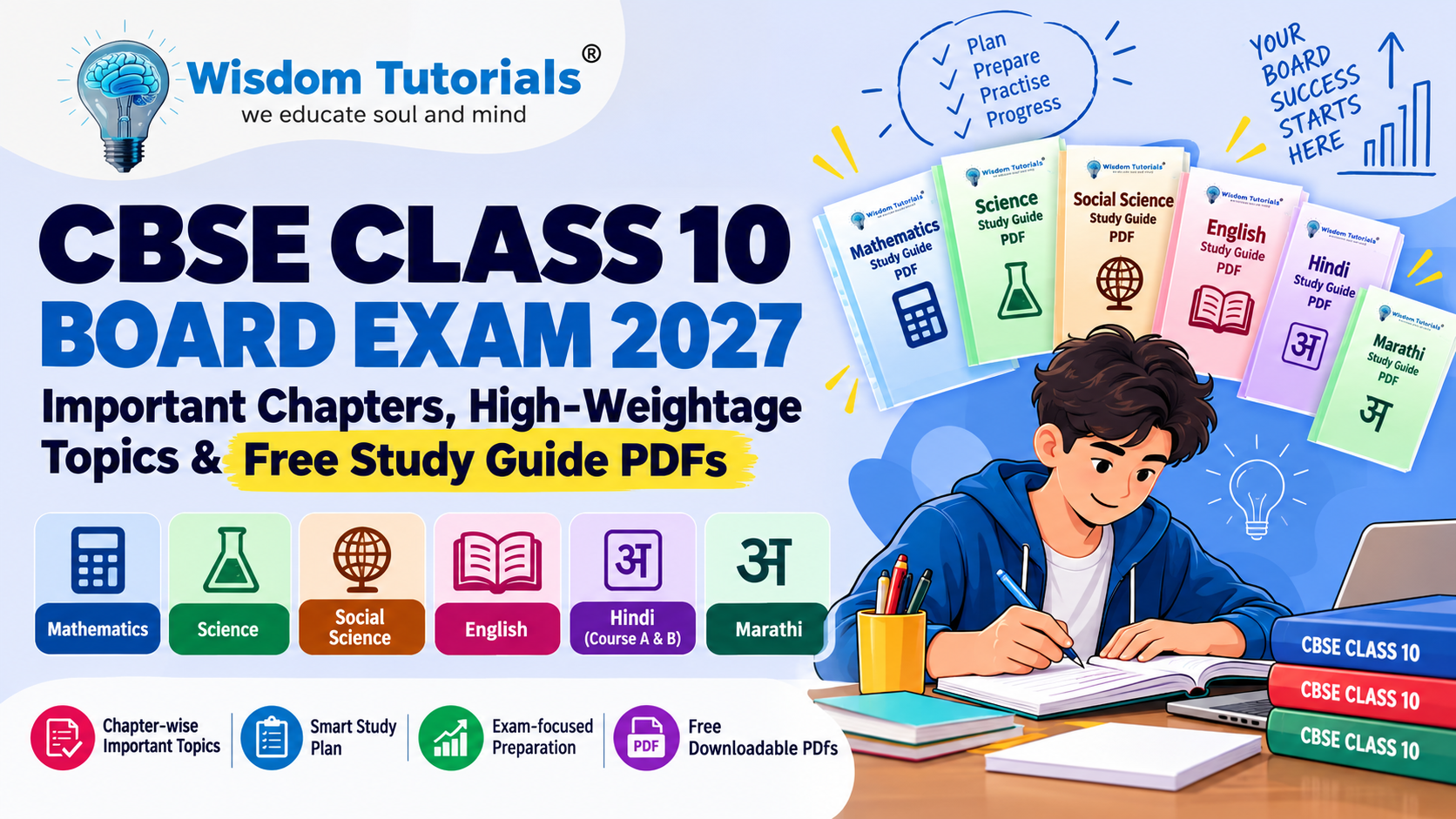
CBSE Class 10 Board Exam 2027: High-Weightage Chapters, Important Topics & Free Subject-Wise Study Guide PDFs
A Complete Smart Study Guide for CBSE Class 10 Students | Academic Year 2026–27
Every year, thousands of CBSE Class 10 students face the same challenge as their Board Examinations approach:
“There is so much to study, but what should I focus on first?”
Some students spend hours reading textbooks without knowing which concepts need more practice. Others concentrate only on important questions and unintentionally ignore chapters that may appear in the examination.
The solution is not simply studying longer.
It is studying with the right strategy.
To help students prepare more effectively for the CBSE Class 10 Board Examination 2027, Wisdom Tutorials has prepared a collection of free, subject-wise smart self-study guides.
These guides are designed to help students understand:
Which chapters deserve additional preparation time.
What important topics to study within each chapter.
How to practise questions independently.
How to evaluate their own preparation.
How to revise the syllabus systematically before the Board Examination.
Whether you are studying in Palghar, Saphale, Dahanu, Boisar or anywhere in India, these free study resources can help you organise your CBSE Class 10 preparation.
What Does High Weightage Mean in the CBSE Class 10 Examination?
Before exploring the subject-wise guides, students should understand one important fact.
CBSE does not guarantee a fixed number of marks from every individual chapter.
For subjects such as Mathematics, Science and Social Science, CBSE provides official unit-wise or section-wise marks distributions.
However, the marks allocated to individual chapters can vary from one question paper to another.
Therefore, a high-priority chapter does not necessarily mean that a specific number of questions will appear from that chapter.
In our study guides, we have classified chapters according to their recommended preparation priority.
Priority A – Intensive Preparation
Chapters that deserve additional conceptual understanding, written practice and revision time.
Priority B – Strong Preparation
Chapters that should be thoroughly prepared through NCERT exercises, important concepts and board-style questions.
Priority C – Focused Revision
Chapters that may require comparatively less preparation time but must still be studied completely.
Remember: Every prescribed chapter matters. Smart preparation means allocating your time effectively, not skipping portions of the syllabus.
1. CBSE Class 10 Mathematics – Important Chapters & Free Study Guide PDF
Mathematics is one of the subjects in which consistent practice can make a significant difference.
Many students understand mathematical concepts during lectures but struggle to apply them independently during examinations.
The key is to combine conceptual understanding with regular problem-solving.
Important Mathematics Chapters to Prioritise
Some chapters that deserve focused preparation include:
Triangles
Quadratic Equations
Pair of Linear Equations in Two Variables
Introduction to Trigonometry
Arithmetic Progressions
Surface Areas and Volumes
Statistics
Some Applications of Trigonometry
Students should also thoroughly prepare Circles, Coordinate Geometry, Real Numbers, Polynomials, Areas Related to Circles and Probability.
What Should Students Focus On?
Important preparation areas include theorem proofs, quadratic equations, word problems, trigonometric identities, applications of heights and distances, grouped-data calculations and problems involving combined solids.
Students should solve NCERT examples and exercises before attempting more challenging board-style questions.
Mathematics Study Tip: Practise at least a few questions daily without referring to solved examples. Maintain a notebook of incorrect questions and solve them again after two or three days.
Download Free CBSE Class 10 Mathematics Study Guide 2026–27
[ MATHEMATICS PDF DOWNLOAD HERE ]
PDF: CBSE Class 10 Mathematics – High-Weightage Chapters, Important Topics & Smart Self-Study Guide
The guide includes all prescribed chapters, recommended preparation priorities, important topics, self-study tasks and official CBSE reference links.
2. CBSE Class 10 Science – Important Chapters & Free Study Guide PDF
Science requires a combination of conceptual understanding, scientific reasoning, diagrams and numerical practice.
Instead of memorising every answer, students should understand the scientific principles behind each concept.
The Class 10 CBSE Science syllabus includes Physics, Chemistry and Biology.
Important Science Preparation Areas
Physics
Students should pay special attention to:
Light – Reflection and Refraction
The Human Eye and the Colourful World
Electricity
Magnetic Effects of Electric Current
Focus on ray diagrams, numerical problems, electrical circuits, formulas and scientific explanations.
Chemistry
Important chapters include:
Chemical Reactions and Equations
Acids, Bases and Salts
Metals and Non-metals
Carbon and its Compounds
Practise balancing chemical equations, identifying reaction types, understanding chemical properties and explaining everyday applications.
Biology
Important chapters include:
Life Processes
Control and Coordination
How Do Organisms Reproduce?
Heredity
Our Environment
Students should focus on biological processes, labelled diagrams, differences between concepts and application-based questions.
Science Study Tip: After completing a chapter, explain the main concepts aloud in your own words. If you cannot explain a process clearly, revise it before moving to the next chapter.
Download Free CBSE Class 10 Science Study Guide 2026–27
PDF: CBSE Class 10 Science – Important Chapters, Topics & Smart Self-Study Guide
The guide covers Physics, Chemistry and Biology, with recommended chapter priorities and self-assessment activities.
3. CBSE Class 10 Social Science – Important Chapters & Free Study Guide PDF
Social Science is often considered a subject that requires extensive memorisation.
However, students who understand historical events, geographical relationships, democratic concepts and economic processes can prepare more effectively.
CBSE Class 10 Social Science consists of four major disciplines.
History – Important Preparation Areas
Focus on:
The Rise of Nationalism in Europe
Nationalism in India
Print Culture and the Modern World
The prescribed board-examination portion of The Making of a Global World
Prepare timelines, historical causes and consequences, important movements and map-based questions.
Geography – Important Preparation Areas
Focus on:
Resources and Development
Agriculture
Minerals and Energy Resources
Manufacturing Industries
Water Resources
Forest and Wildlife Resources
Practise map work regularly using the official CBSE map-work list.
Political Science – Important Preparation Areas
Focus on:
Power-sharing
Federalism
Gender, Religion and Caste
Political Parties
Outcomes of Democracy
Understand the concepts through real-life examples and comparisons.
Economics – Important Preparation Areas
Focus on:
Development
Sectors of the Indian Economy
Money and Credit
Prescribed topics from Globalisation and the Indian Economy
Students should practise questions involving economic situations, comparisons and reasoning.
Social Science Study Tip: Instead of repeatedly reading a chapter, create a one-page summary containing important dates, definitions, causes, effects and examples.
Download Free CBSE Class 10 Social Science Study Guide 2026–27
[ SOCIAL SCIENCE PDF DOWNLOAD HERE ]
PDF: CBSE Class 10 Social Science – History, Geography, Political Science & Economics Smart Study Guide
4. CBSE Class 10 English – Important Topics & Free Study Guide PDF
English preparation is not limited to reading literature chapters.
Students must develop reading comprehension, grammar, writing and analytical skills.
The CBSE English Language & Literature examination includes:
Reading Skills – 20 marks
Writing Skills and Grammar – 20 marks
Language through Literature – 40 marks
Important English Preparation Areas
First Flight
Prepare the themes, characters, messages and important events of prescribed prose chapters and plays.
Poetry
Focus on central ideas, imagery, symbolism, poetic devices, tone and interpretation.
Footprints Without Feet
Understand character development, important events, turning points and the message of each story.
Grammar and Writing
Practise grammar questions, formal letters, analytical paragraphs and unseen passages.
English Study Tip: Reading an answer and writing an answer are two different skills. Practise writing your own answers within the prescribed word limit.
Download Free CBSE Class 10 English Study Guide 2026–27
PDF: CBSE Class 10 English – Important Literature Topics, Grammar, Writing & Self-Study Guide
5. CBSE Class 10 Hindi – Course A & Course B Free Study Guide PDFs
CBSE offers Hindi through two different courses.
Hindi Course A (002) and Hindi Course B (085) have different prescribed textbooks and examination structures.
Students should download the guide corresponding to their registered subject.
Hindi Course A
The prescribed literature includes Kshitij Bhag–2 and Kritika Bhag–2, subject to the official 2026–27 syllabus.
Students should focus on:
गद्य और पद्य का केंद्रीय भाव
पात्रों का चरित्र-चित्रण
काव्य-सौंदर्य और भाषा
व्यावहारिक व्याकरण
अपठित बोध
रचनात्मक लेखन
[ HINDI COURSE A PDF DOWNLOAD HERE ]
Hindi Course B
The prescribed literature includes Sparsh Bhag–2 and Sanchayan Bhag–2, subject to the official 2026–27 syllabus.
Important preparation areas include:
पाठों का सारांश और संदेश
कविताओं का भावार्थ
पदबंध, समास और मुहावरे
अपठित बोध
लेखन कौशल
[ HINDI COURSE B PDF DOWNLOAD HERE ]
Hindi Study Tip: पाठ पढ़ने के बाद पुस्तक बंद करके उसका सारांश अपने शब्दों में लिखें। इससे समझने और उत्तर लिखने की क्षमता बेहतर होती है।
6. CBSE Class 10 Marathi – Important Topics & Free Study Guide PDF
For students who have selected Marathi as a language subject, preparation should include literature, grammar, comprehension and writing skills.
Important Marathi Preparation Areas
गद्यपाठांचे आशय व महत्त्वाचे मुद्दे
कवितांचा भावार्थ आणि काव्यवैशिष्ट्ये
व्याकरण आणि शब्दसंपत्ती
अपठित उताऱ्यांचे आकलन
निबंध, पत्रलेखन आणि इतर लेखन कौशल्ये
संदर्भासह स्पष्टीकरण
Students should refer to the official CBSE Marathi syllabus to confirm the prescribed lessons and examination requirements.
Marathi Study Tip: प्रत्येक धडा वाचल्यानंतर त्याचा मुख्य आशय स्वतःच्या शब्दांत लिहा. कविता समजून घेण्यासाठी तिचा भावार्थ आणि संदेश स्पष्ट करा.
Download Free CBSE Class 10 Marathi Study Guide 2026–27
PDF: CBSE Class 10 Marathi – Important Topics, Grammar & Smart Self-Study Guide
How to Prepare Smartly for the CBSE Class 10 Board Examination 2027
Downloading study material is only the first step.
Your daily study habits will determine how effectively you use it.
Here are six practical strategies every Class 10 student should follow.
1. Complete NCERT Before Moving to Additional Books
NCERT textbooks should form the foundation of your preparation.
Read the prescribed chapters carefully, solve the textbook questions and understand the concepts before attempting additional reference material.
2. Create a Chapter-Wise Preparation Checklist
Divide chapters into three categories:
Strong – You can solve questions independently.
Needs Practice – You understand the concept but make mistakes.
Needs Revision – You struggle to recall or apply the concept.
Spend more time on the second and third categories while continuing to revise your stronger chapters.
3. Practise Competency-Based Questions
CBSE examinations assess more than memorisation.
Students should practise application-based, analytical, case-based and reasoning questions according to the pattern of each subject.
Ask yourself:
“Can I apply this concept if the question is presented in a different way?”
4. Solve Official CBSE Sample Question Papers
Official sample papers help students understand question-paper structure, instructions, marks distribution and expected answer formats.
After solving a sample paper, compare your answers with the official marking scheme.
Do not simply count your marks. Identify why you lost them.
5. Maintain a Mistake Notebook
Whenever you make an error, record:
The question or concept.
The mistake you made.
The correct method or explanation.
The date on which you will revise it.
This simple habit can make revision more focused.
6. Practise Time Management
Knowing the answer is important, but completing the examination within the allotted time is equally essential.
Attempt full-length papers under examination conditions.
Avoid using textbooks, notes or mobile phones during timed practice.
A Simple Daily Study Routine for Class 10 CBSE Students
A balanced study routine can help students prepare consistently without becoming overwhelmed.
| Activity | Suggested time |
|---|---|
| Mathematics problem-solving | 45 minutes |
| Science concepts and questions | 45 minutes |
| Social Science revision | 30 minutes |
| English / Hindi / Marathi | 30 minutes |
| Previous mistakes and quick revision | 15 minutes |
Total: Approximately 2 hours and 45 minutes of focused self-study.
This is an illustrative routine, not a compulsory schedule. Students should adjust it according to schoolwork, coaching classes, learning needs and upcoming examinations.
Consistency matters more than studying for unusually long hours on a single day.
CBSE Class 10 Board Exam 2027: Official Resources Every Student Should Know
Students should always use reliable sources when preparing for board examinations.
For official curriculum information, sample question papers and marking schemes, visit:
CBSE Academic Website: https://cbseacademic.nic.in/
CBSE Curriculum: https://cbseacademic.nic.in/curriculum_2027.html
CBSE Class 10 Sample Papers 2026–27: https://cbseacademic.nic.in/SQP_CLASSX_2026-27.html
The Wisdom Tutorials study guides are independent educational resources intended to support preparation alongside official CBSE material.
Looking for CBSE Class 10 Coaching in Palghar or Saphale?
While self-study is essential, some students benefit from additional academic guidance, structured revision and regular assessments.
At Wisdom Tutorials, we believe that effective learning requires conceptual clarity, consistent practice and individual attention.
Our approach focuses on helping students understand concepts rather than simply memorising answers.
For Class 10 CBSE students, structured preparation can include:
Concept-based teaching.
Regular tests and performance evaluation.
Doubt-solving and academic guidance.
Revision and board-style question practice.
Individual attention to students' learning difficulties.
With branches in Palghar West and Saphale East, Wisdom Tutorials supports students preparing for their school and board examinations.
Students and parents from Palghar, Saphale and nearby areas can contact our team to learn more about available CBSE batches and academic support.
Wisdom Tutorials – We Educate Soul and Mind.
Website: https://www.wisdomtutorials.in
Enquiry: 9970247971
Frequently Asked Questions About CBSE Class 10 Board Exam 2027
Q1. Which chapters are most important for CBSE Class 10 Board Exam 2027?
Important chapters vary by subject. Mathematics students should give additional attention to Algebra, Geometry and Trigonometry, while Science students should thoroughly prepare Physics, Chemistry and Biology concepts. However, students should complete every prescribed chapter rather than studying only selected topics.
Q2. Does CBSE provide official chapter-wise weightage for Class 10?
CBSE provides official marks distributions by units or sections for relevant subjects. It does not guarantee fixed marks from every individual chapter. Chapter-wise priority lists should therefore be treated as preparation guidance rather than confirmed examination weightage.
Q3. Are NCERT textbooks enough for CBSE Class 10 preparation?
NCERT textbooks are the foundation of preparation. Students should complete prescribed NCERT content and practise official CBSE sample papers, marking schemes and relevant board-style questions to improve examination readiness.
Q4. How can I score 90% or above in CBSE Class 10?
A strong preparation strategy includes completing the syllabus, understanding concepts, practising written answers, revising regularly, solving timed sample papers and correcting mistakes. No single strategy guarantees a particular score.
Q5. Where can I download free CBSE Class 10 study guides for 2027?
You can download free subject-wise study guides for Mathematics, Science, Social Science, English, Hindi and Marathi from this Wisdom Tutorials article using the PDF download links provided above.
Q6. How many hours should a Class 10 student study daily?
There is no fixed number of hours suitable for every student. A consistent daily routine with focused study sessions, regular breaks, practice questions and revision is generally more effective than irregular long study sessions.
Q7. Where can I find CBSE Class 10 coaching in Palghar or Saphale?
Wisdom Tutorials offers academic support for CBSE students through its Palghar and Saphale branches. Parents can contact the institute to enquire about current batches, timings and admission availability.
Final Words: Study Smart, Stay Consistent and Prepare with Confidence
The CBSE Class 10 Board Examination is an important academic milestone, but preparation does not need to become a race to memorise every possible question.
The most effective approach is to understand the syllabus, build strong concepts, practise consistently and evaluate your progress.
Our free CBSE Class 10 study guides are designed to help you take the next step towards more organised and independent learning.
Download the subject-wise PDFs, prepare your study plan and start practising today.
At Wisdom Tutorials, we believe in one simple principle:
Roj Padhenge • Thoda Padhenge • Acche Se Padhenge.
Because consistent effort, supported by the right guidance, can lead to meaningful improvement.
Wisdom Tutorials – We Educate Soul and Mind.
Disclaimer: This article is an independent educational guide prepared by Wisdom Tutorials. CBSE may revise curriculum details, examination instructions or sample materials. Students should always refer to official CBSE publications for the latest applicable information. Recommended chapter priorities are not guaranteed question predictions.





 – Important Update for Palghar, Saphale, Boisar & Dahanu Students/KEjkZL3sne7aFAkAa518KbgU53j9sBiQtzcxEJfs.png)